About Stephen Scott Douglas
Summary
Writer, decoder of trolls, cultural archaeologist. Vibe-coder, code switcher, and inventor of the Code of Positive Trolls. If you want to understand more of what I mean by self-identifying as a writer, feel free to watch this short video:
Business School Buddhist Discovers Disinfolklore and Becomes a Cultural Archaeologist!
Across ten years, five platforms, two pandemics (Covid and Disinfolklore), one war, and one linguistic discovery, a single analytical practice has remained constant in my writing:
Reading quotidian data for archetypal truthful content.
Whether the data is a village leader in now occupied eastern Ukraine’s response to shelling (“Normal… Well…”), a government website’s disappearing Covid testing data, a Russian president’s necrophilic r*pe reference to a song called “Sleeping Beauty in a Coffin,” a computer folder labelled “Folklore,” or a warehouse sign reading “Manuland” — the method is the same:
- Notice what is IMMANENT in the surface data
- Apply an EVALUATIVE FRAMEWORK (human rights → Code of Positive Trolls)
- Switch between SCALES (molecular → personal → geopolitical → civilisational → 6,000 years)
- Make a PREDICTION based on what is structurally inevitable
- Test the prediction against what actually happens
This is what 6,000 years of mythological, linguistic, and cultural history being immanent in the analysis of everyday memes looks like. It is the method of a writer and a Cultural Archaeologist — unpacking layers of culture over time to reveal the deep structures that still shape our present.
The method was not invented by me. It was discovered — through lived experience on a bridge in eastern Ukraine, refined through a pandemic, named through a happy accident with a computer folder, and validated through 25+ predictions that outperformed the world’s intelligence services.
Disinfolklore.eu is the first manual in Mana mindfulness. And it is archetypal Infolklore. For the full precis of my intellectual development from a Business School Buddhist to my discovery of Disinfolklore: here is a summary of my online writing 2016 - 2026.
The Bridge
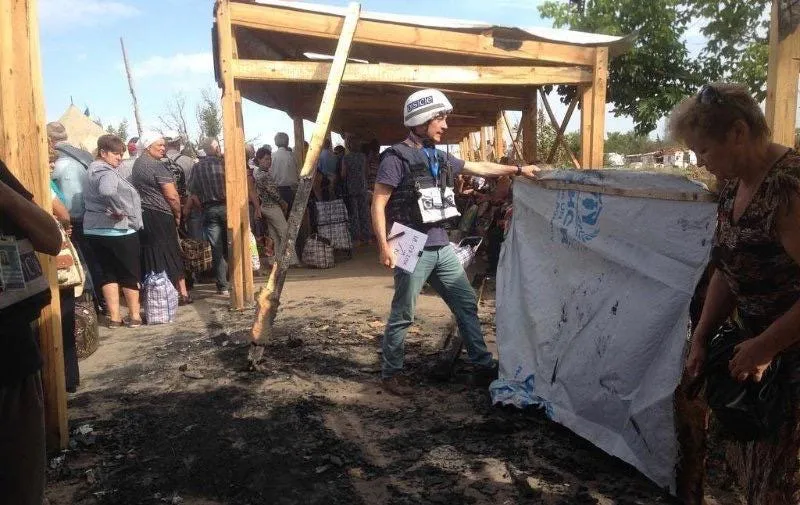
I engineered the term Disinfolklore from my experience as a diplomat on that bridge at Stanitsia Luhanska in eastern Ukraine. For several years I negotiated daily with armed Russian bridge trolls guarding one side of the bridge, and with the Ukrainian armed forces guarding the other.
Source: Disinfolklore (1)
The wooden and iron bridge spanning the Donets River at Stanitsia Luhanska — where 10,000 civilians crossed daily between free Ukraine and Russia-occupied territory — is the origin story of everything on this site.
Ground Truth
I lived in eastern Ukraine for seven years. I met thousands of native Russian language speaking Ukrainians. Between 2015 and 2022, as a diplomat, I had detailed conversations with over one thousand elected political leaders, community leaders, Civil Society Organisation activists, teachers, police, military and ordinary people in a variety of contexts, including at the Bridge. I was also living embedded in the very communities in eastern Ukraine which Russian Disinfolklore claimed were being held hostage by Nazis.
Source: Disinfolklore (10)
As part of my job, I would write daily reports to be read by the fifty-seven nation states that I served as a diplomat working for the Organization for Security and Co-operation in Europe.
Source: Disinfolklore (1)
One of the few Westerners ever to live inside Russia’s occupation in Ukraine, the author spent seven years (2015—2022) as a diplomat with the OSCE Special Monitoring Mission, establishing facts in relation to security incidents related to Russia’s military occupation. The daily experience of negotiating with armed trolls — literal bridge guardians — while simultaneously watching Brexit and the 2016 US election unfold through Disinfolklore became the foundation of the analytical method described across this site.
The Insight
Working in that Steppe-land, I realised that I perceived part of reality through cognitive lenses — archetypes — that had entered my mind as a small child from folktale-inspired stories. Russian Disinfolklorists were leaning into this aspect of Indo-Europeans’ cognition.
Source: Archetypal Disinfolklore
During my forays back to Oxford, I watched as England was being convulsed by Disinformation persuading it to Brexit. As an American diplomat, then, I also felt the onslaught of “truthiness” and reality denial that took hold during and after 2016.
Source: Disinfolklore (1)
The bridge in eastern Ukraine and the libraries of Oxford produced the method simultaneously. On one side: the raw data of Russian Disinfolklore operating in real time. On the other: the Indo-European scholarship that revealed why the archetypes worked.
Academic Path
While working there as a diplomat in eastern Ukraine, I was also doing a masters degree at Oxford University. I would travel from that war zone every six weeks or so to spend a week or two enmeshed in the libraries of an other Other World — the ancient city of Oxford. Out of these two clashing experiences is wrought this series: Disinfolklore.
Source: Disinfolklore (1)
Born in Dublin. Educated at the universities of Montpellier, Hansard Society Scholar at LSE, Georgetown, Dublin, Cambridge (Trinity Hall, Law), and Oxford (Linacre/Said Business School). Trained as a lawyer before entering diplomatic service. The Finding Manuland research — tracing the M-N- sound pattern across 6,000 years of Indo-European culture — grew out of the Oxford studies.
OSCE Moscow Mechanism Report
Cited as a Main Source in the OSCE Moscow Mechanism Report (ODIHR.GAL/26/22/Rev.1, April 2022) — the international community’s first report on Russia’s violations of international humanitarian and human rights law following the full-scale invasion of Ukraine on 24 February 2022. The report was invoked by 45 OSCE participating States.
The ECHR Grand Chamber subsequently placed “substantial weight” on the OSCE mission reports in Ukraine and the Netherlands v. Russia (Applications nos. 8019/16, 43800/14, 28525/20 and 11055/22), the definitive judgment on Russia’s conduct in Ukraine since February 2014. Paragraph 199:
The reports by the OSCE mission of experts contain important factual information on the events in Ukraine after 24 February 2022, much of it from primary sources. The Court therefore considers it appropriate to place substantial weight on the objective factual reporting contained in these reports.
Six Perfections
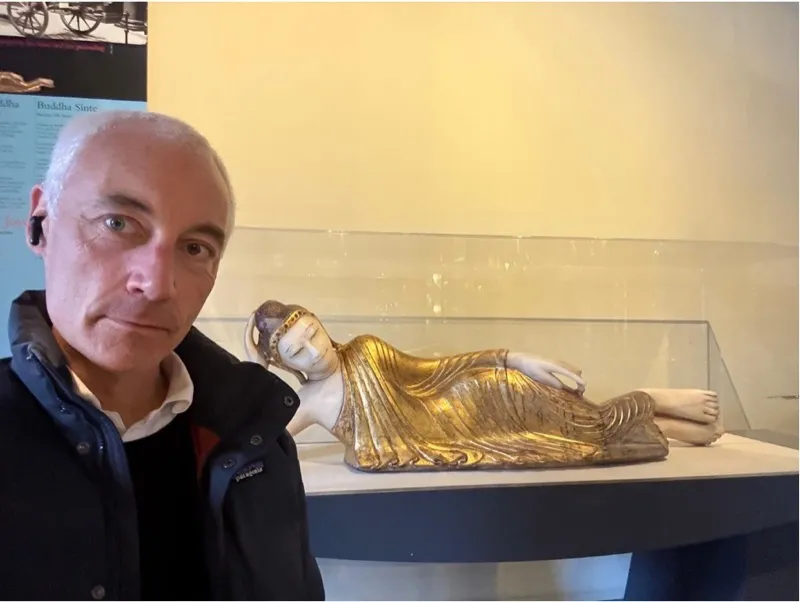
As soon as I read Oxford University Press’s The Six Perfections I knew I had what I was looking for. If you conceive (as I do) of every emotionally resonant movement of body speech and mind as a “troll,” then it becomes necessary to have a means of evaluating such trolls. An evaluative dimension consisting of criteria with which we can assess whether such trolls/memes/informational units are positive, negative or neutral is necessary. Throughout 2018 and 2019, I was searching for just such an evaluative framework. The Code of Positive Trolls is derived from that book: Generosity, Right, Patience, Energy/Mana, Focus and Insight.
Publications
This site hosts two interconnected publications:
- Disinfolklore (~80%) — the analytical framework, Twelve Tools, Mechanisms, Collections, and Archetypes
- Finding Manuland (~20%) — the foundational Indo-European research that provides the “source code” for the Disinfolklore framework
The author writes under the pseudonym Decoding Trolls on Substack and X (Twitter).
Fiction
Alejo de Focking Eurotrash — a novella by Stephen Douglas. Available at Amazon, Barnes & Noble, Smashwords, Apple Books, Indigo, and Fnac.